Do more with less: How total stations enable one-person layout
Blog Post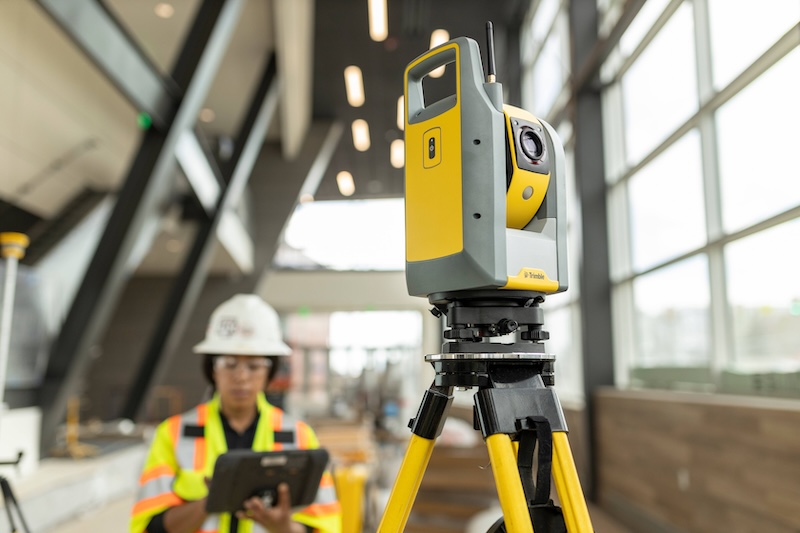
Labour is tight. Timelines are tighter. And on most jobsites, everyone is being asked to do more with less.
That’s exactly why more Canadian contractors are rethinking how they approach layout.
For years, layout has typically meant a two-person crew: one running the instrument, one on the rod. It worked, but it wasn’t exactly efficient. Today, robotic total stations are changing that model entirely.
Now, one person can handle layout on their own — faster, with less back-and-forth, and often with better accuracy.
Why traditional layout is starting to fall behind
If you’ve been on site long enough, you know the drill: Two people, constant communication, repositioning, checking, double-checking, waiting.
It’s not that the process is broken; it’s just not built for today’s realities:
- Skilled labour is harder to find
- Crews are stretched thinner
- Projects are moving faster
- Margins leave less room for inefficiency
When two people are tied up doing layout, that’s two people not doing something else.
What changes with a robotic total station?
Robotic total stations flip the workflow. Instead of needing someone behind the instrument, the system automatically tracks the person holding the rod. The operator can control everything directly. There’s no shouting across the site, no hand signals, and no guesswork.
In practical terms, that means:
- One person can perform layout independently
- The instrument follows and stays locked on target
- Points can be laid out faster and with fewer interruptions
- You’re working from digital data, not manual interpretation
It’s a simpler way to work, and once teams get used to it, it’s hard to go back.
What one-person layout actually looks like on site
This isn’t theoretical. In fact, it’s already happening on jobsites across Canada.
A typical workflow might look like this:
- Load your model or layout points
- Set up the total station
- Start laying out points solo, with the instrument tracking you automatically
- Mark, verify, and move on — without a second person
No waiting. No relaying instructions. No stopping every few minutes to realign.
There’s just steady, continuous progress.
The real benefit: freeing up your crew
The obvious benefit is reducing a two-person crew to one. But the bigger impact is what that frees up. That second person can now:
- Support another crew
- Move materials
- Prep the next phase of work
- Focus on higher-value tasks
On a busy site, that flexibility adds up quickly.
Productivity gains you can actually feel
Most teams notice the difference pretty quickly. With robotic total stations, you can expect:
- Faster layout times
- Fewer interruptions during the workflow
- Less rework due to improved accuracy
- More consistent results across operators
Beyond speed, you also benefit from smoother execution from start to finish.
“Can one person really handle layout?”
That’s a fair (and common) question.
The short answer? Yes.
Robotic total stations are designed to maintain lock and accuracy automatically. In many cases, they actually reduce the variability that comes with two-person communication.
There’s also less room for misinterpretation. The person placing the point is the same person controlling the system.
Getting teams comfortable with the shift
Like any change, there’s a bit of a learning curve, but it’s usually shorter than people expect.
Most crews pick it up quickly, especially when they see:
- How much walking and waiting is eliminated
- How intuitive modern interfaces have become
- How much more control they have over the process
Once operators get comfortable, the old way starts to feel really slow by comparison.
Why more contractors are making the switch
This shift isn’t about chasing new technology for the sake of new technology. It’s about solving real, everyday problems on site.
Across the industry, contractors are dealing with:
- Labour shortages
- Increasing project complexity
- Higher expectations for accuracy and documentation
- Pressure to deliver more with the same (or fewer) resources
One-person layout directly addresses all of those challenges.
Where to start
If you’re considering making the move, the best place to start is with your current workflow.
Ask:
- Where is layout slowing us down?
- How many people are tied up in the process?
- Where are errors or rework happening?
From there, it becomes much easier to see where a robotic total station can make an impact.
Want to learn more? Contact us for a demo and consultation of the Trimble Ri.
Latest Posts
Ready to invest in your own 3D laser scanning solution?
What Canadian contractors should consider before making the leap to a 3D laser scanning solution investment Across Canada’s construction industry,…
5 ways 3D laser scanning transforms steel and MEP projects
A practical guide for Canadian fabricators, erectors, and mechanical, electrical, and plumbing contractors TLDR: Precision and efficiency aren’t optional in construction;…
Why Canadian contractors are switching to 3D laser scanning
...and why more general and concrete crews are adding it to their workflow TLDR: In construction, getting the job done right the first…