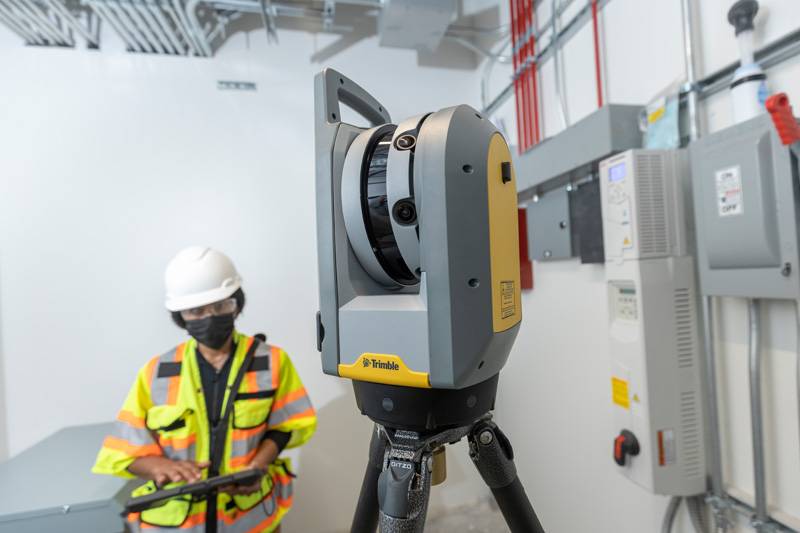
Ready to invest in your own 3D laser scanning solution?
Blog Post
What Canadian contractors should consider before making the leap to a 3D laser scanning solution investment
Across Canada’s construction industry, pressure is mounting to build faster, reduce rework, and deliver higher-quality projects with fewer skilled workers. As jobs become more complex and coordination between trades tightens, many contractors are asking the same question:
Should we invest in a 3D laser scanning solution?
3D laser scanning has moved well beyond a niche technology used only by surveyors or BIM specialists. Today, it’s a practical, field-ready tool used for layout verification, quality control, prefabrication, and as-built documentation. If you’re considering bringing scanning in-house, here’s what you need to know about 3D laser scanners to make a smart, informed decision.
Why Canadian contractors are investing in 3D laser scanning
- Accuracy you can trust
Laser scanning captures millions of data points in minutes, creating a highly accurate digital record of existing site conditions. For contractors, this means fewer assumptions and far greater confidence when making layout, fabrication, or coordination decisions.
Whether you’re verifying slab flatness, checking anchor bolt placement, or validating MEP clearances, scanning ensures work is built to plan — and to tolerance. 
- Faster data capture, faster decisions
Traditional site measurement takes time and ties up skilled labour. Scanning dramatically reduces the time needed to capture site conditions and makes that data instantly shareable with project teams, engineers, and fabricators.
Instead of waiting for re-measurements or clarification, teams can make decisions quickly, keeping projects on schedule, even when conditions change.
- Reduced rework and long-term cost savings
Rework is one of the most expensive issues in construction. By identifying issues early —before concrete is poured or components are fabricated — scanning helps prevent costly fixes and delays.
While the upfront investment in scanning technology is real, many Canadian contractors find the payback comes quickly through:
- Fewer errors
- Less rework
- Improved productivity
- Better coordination between trades
Over time, scanning often pays for itself. 
- Better collaboration across the project team
Scan data can be easily shared as point clouds or models, giving everyone, from field crews to designers, a single, reliable source of truth.
This improves:
- Communication between trades
- BIM and coordination meetings
- RFI resolution
- Documentation for owners and project managers
For contractors working on complex, multi-trade projects, this shared visibility is a major advantage.
- Stronger quality control and documentation
Laser scanning supports detailed quality control by allowing teams to compare installed work directly against design models. This makes it easier to confirm that work meets specifications and tolerances before the next phase begins.
It also creates a defensible record of what was built and when, an increasingly important requirement on Canadian projects.

Key factors to consider before investing
Bringing scanning in-house is a strategic decision. Before you commit, consider the following:
- Your typical project needs
Think about the types of projects you regularly take on. Do you perform layout? Concrete work? Steel or MEP installation? Prefabrication? Scanning delivers the most value when it directly supports your core workflows.
- Budget and return on investment
While scanning technology represents a capital investment, it’s important to evaluate the long-term return — not just the purchase price. Reduced rework, improved efficiency, and better coordination often outweigh the initial cost.
Many contractors also explore phased adoption, rentals, or financing options to get started.
- Training and ongoing support
Technology is only as effective as the people using it. Access to proper training and local support is critical to realizing the full value of scanning.
This is where working with a knowledgeable Canadian partner matters. Hands-on training, workflow guidance, and ongoing support help ensure scanning becomes part of your day-to-day operations—not a tool that sits unused.
- Compatibility with your existing tools
Scanning should fit seamlessly into your current workflows. Look for solutions that integrate with the software and field tools you already use for layout, coordination, and project management.
The easier the integration, the faster your team will see results.
- Scalability for future growth
As your business grows, your scanning needs may grow with it. Choosing a scalable solution ensures you can expand capabilities—whether that’s more frequent scanning, larger sites, or more advanced workflows—without starting over.
Making the right choice for your business
Investing in a 3D laser scanning solution can be a turning point for your construction operations. With the right approach, scanning helps Canadian contractors deliver higher-quality work, reduce risk, and stay competitive in an increasingly demanding market.

The key is choosing not just the right technology—but the right partner to help you implement it successfully.
Learn how scanning can work for you
BuildingPoint Canada works with contractors across the country to help them evaluate, implement, and scale 3D laser scanning solutions. From demos and training to workflow consulting and ongoing support, our team helps ensure scanning delivers real value on your projects. Contact us to learn more.
Latest Posts
Why scaffolding planning is becoming a competitive advantage for Canadian general contractors
How scaffolding planning software helps general contractors reduce risk and improve project outcomes Across Canada, general contractors are navigating a difficult mix of conditions: rising costs, ongoing labour constraints, and projects that leave very little…
Do more with less: How total stations enable one-person layout
Labour is tight. Timelines are tighter. And on most jobsites, everyone is being asked to do more with less. That’s exactly why more Canadian contractors are rethinking how they approach layout. For years, layout has…
5 ways 3D laser scanning transforms steel and MEP projects
A practical guide for Canadian fabricators, erectors, and mechanical, electrical, and plumbing contractors TLDR: Precision and efficiency aren’t optional in construction; they’re the difference between staying on schedule and falling behind. For steel and mechanical,…