Why scaffolding planning is becoming a competitive advantage for Canadian general contractors
Blog Post
How scaffolding planning software helps general contractors reduce risk and improve project outcomes
Across Canada, general contractors are navigating a difficult mix of conditions: rising costs, ongoing labour constraints, and projects that leave very little room for error. In this environment, the difference between a profitable job and a painful one often comes down to execution.
Often, that includes how scaffolding is planned.
The hidden impact of scaffolding on project performance
Scaffolding is essential on many projects, but it’s rarely treated as a core part of the planning process.
Too often, it’s scoped late, estimated manually, and then managed separately from the model and project data. You’re probably familiar with the results when this happens:
- Material overages or shortages
- Delays while designs are clarified or adjusted
- Rework when conditions change on site
- Safety and coordination risks
Individually, these issues might seem manageable. But across a project — or multiple projects — they can add up quickly.
In a better market, that inefficiency might be absorbed. Today, though? That can really impact your profitability.
Why this matters more now
The construction isn’t just dealing with higher costs right now, it’s dealing with less flexibility.
Material costs are volatile. Labour shortages mean teams are already stretched. And (as always) project timelines are under pressure from every direction. There’s just less tolerance for inefficiency anywhere in the workflow.
For general contractors, that means looking beyond the major trades and asking:
- Where are we still relying on manual processes?
- Where are we introducing risk without realizing it?
Scaffolding planning is one of those areas.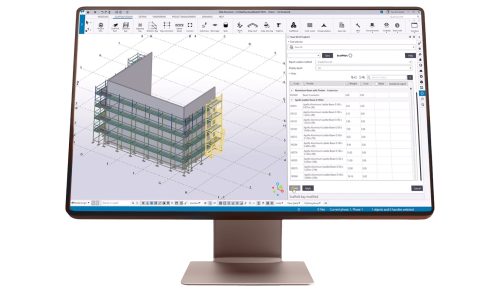
From manual process to digital workflow
This is where tools like ScaffPlan are starting to change the conversation.
Instead of treating scaffolding as a separate, manual process, ScaffPlan brings it into a connected digital workflow, right alongside the rest of your project planning.
That shift has a few important implications:
- Better visibility earlier in the project. Scaffolding can be designed in 3D, adjacent to your models, making it easier to identify conflicts, challenges with access, and any inefficiencies before they can impact the schedule.
- More accurate material planning. Automatic, model-based material lists replace manual takeoffs. That means you’re reducing waste, avoiding shortages, and improving cost predictability – all good things.
- Faster response to change. When designs evolve (and, honestly, don’t they always?), scaffolding plans can be updated quickly — without restarting the process from scratch.
- Clearer communication across teams. Visual, standardized scaffold designs make it easier for field teams, subcontractors, and stakeholders to understand the plan and execute more confidently.
A small change that adds up across the project
Scaffolding isn’t the biggest line item on most jobs, but it does touch a lot of them! Scaffolding affects:
- Access and sequencing
- Labour productivity
- Safety and compliance
- Coordination between trades
When planning is disconnected, those impacts can ripple across the entire project. And when it’s integrated and predictable, it helps stabilize everything around it.
Where this fits for general contractors
For GCs, this isn’t about becoming scaffolding experts. We know that’s not your priority. Rather, it’s about:
- Reducing risk in planning and execution
- Improving coordination between trades
- Delivering projects more predictably
Ultimately, that comes down to protecting margin in a market where every percentage point matters.
What this means for connected construction
What’s happening with scaffolding is actually part of a larger shift. General contracting has been moving toward more connected workflows. These are workflows where design, estimating, and execution are aligned, and data flows across the project instead of being recreated at each step.
ScaffPlan fits into that shift by solving for a gap that is often overlooked. It brings scaffolding into the same digital ecosystem as your other tools (whether that’s Tekla, Revit, or SketchUp) and helps ensure that nothing critical is left to guesswork.
Final thought
Your competitive advantage right now needs to be about more than winning work; it also has to be about delivering it efficiently. The contractors who come out ahead won’t just be the ones with the best bids. They’ll be the ones with the most controlled, predictable execution.
Sometimes, that starts in places you don’t expect.
If you’re looking at ways to improve coordination, reduce rework, and bring more predictability to your projects, ScaffPlan is worth a closer look.
Learn more or schedule a demo – form is at the bottom of the page!
Latest Posts
Do more with less: How total stations enable one-person layout
Labour is tight. Timelines are tighter. And on most jobsites, everyone is being asked to do more with less. That’s exactly why more Canadian contractors are rethinking how they approach layout. For years, layout has…
Ready to invest in your own 3D laser scanning solution?
What Canadian contractors should consider before making the leap to a 3D laser scanning solution investment Across Canada’s construction industry, pressure is mounting to build faster, reduce rework, and deliver higher-quality projects with fewer skilled…
5 ways 3D laser scanning transforms steel and MEP projects
A practical guide for Canadian fabricators, erectors, and mechanical, electrical, and plumbing contractors TLDR: Precision and efficiency aren’t optional in construction; they’re the difference between staying on schedule and falling behind. For steel and mechanical,…